
Scheduling Under Constraint: What Ploky Is Teaching Us About Operational Software
ResearchComplex scheduling is rarely an AI problem first. It is a constraints problem. Building Ploky has reinforced why explicit rules, priorities and auditability can matter more than adding intelligence for its own sake.
About this research
Scheduling is a constraint system
Complex scheduling can look like an intelligence problem. A finished agenda appears to balance many moving parts, so it is tempting to assume that a more intelligent model will produce a better answer. Building Ploky has reinforced a different starting point: complex scheduling is usually a constraints problem first.
Consider an investor day, roadshow or series of board meetings. People, rooms and time slots have different availability. Blackouts remove options. Some conversations must happen before others, while competing priorities mean two sensible choices may not work together.
The challenge is not simply to generate a plausible timetable. It is to produce a schedule that respects the rules of the event and can be understood by the people operating it.
Rules should remain rules
Ploky’s scheduling engine is deliberately rule- and priority-based. Availability, room eligibility, meeting duration, blackouts and other operational requirements are represented as explicit constraints. Priorities provide a controlled way to choose between valid alternatives when every preference cannot be satisfied at once.
That distinction matters. A hard constraint should not become a flexible guess because an algorithm found a schedule that looks convenient. If a participant is unavailable, a room is unsuitable or two required meetings overlap, the system should not quietly reinterpret the rule. It should reject the conflict or make the trade-off visible.
Operational software should be able to explain why something was scheduled, why an alternative failed and which rule would need to change.
A deterministic approach also makes behaviour repeatable. Given the same inputs, rules and priorities, the engine can produce the same result. When an organiser changes a constraint, the effect can be traced to that change rather than to an opaque shift in model behaviour.
Constraint systems can still become computationally demanding as people, rooms and combinations grow. The complexity, however, remains expressed through the real operating rules.
The Schedule Board makes the system visible
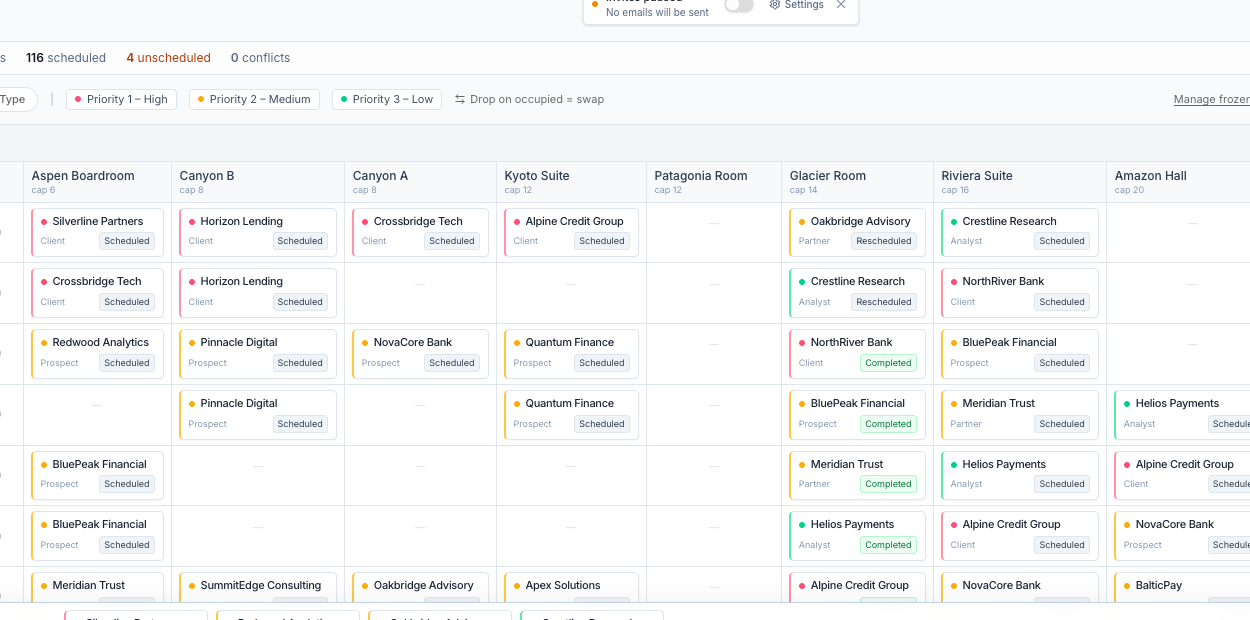
A scheduling engine is useful only if operators can understand and work with its output. Ploky’s Schedule Board provides a shared view of meetings across rooms and time slots. It turns the schedule into something that can be scanned, checked and adjusted rather than leaving it as a hidden calculation.
When plans change, operators need to see the current state, identify affected meetings and understand whether an adjustment creates another conflict.
The board supports that work by keeping time, location and meeting context together. The goal is not to remove the operator. It is to give the operator a reliable view of a complicated system so changes can be made deliberately.
Auditability matters when plans move
Scheduling decisions rarely exist in isolation. A change may affect participants, room teams, event organisers and requesters. An audit trail helps preserve what changed, when it changed and how the current schedule was reached.
While an event evolves, that history helps operators distinguish the current plan from earlier versions and trace unexpected movement without relying on memory.
Requester flows are another part of the operational system. A meeting request needs enough structure to be scheduled: relevant participants, duration, availability, priority and any room or timing requirements. Clear flows help requesters provide that information while allowing the operations team to review, resolve conflicts and maintain control of the final schedule.
Together, the Schedule Board, requester flows and audit trail make the engine’s decisions usable. The rule system determines what is valid; the interface helps people inspect, operate and communicate the result.
Where AI may help around the edges
A rule-based core does not mean AI has no role. There are useful possibilities around the edges of the scheduling process, particularly where people express requirements in natural language.
In future exploration, AI could help interpret a free-text request such as “schedule this after the strategy session, preferably with the finance lead present.” It could translate that request into proposed constraints for a person to confirm. It might explain a conflict in ordinary language or suggest valid alternatives when the preferred slot is unavailable.
Those are potential directions, not shipped Ploky capabilities. They would also need clear boundaries. An AI explanation should reflect the underlying rule system rather than invent a reason. A suggested alternative should be validated by the scheduling engine before it is presented as workable. Free-text interpretation should create a reviewable proposal, not silently turn an ambiguous sentence into an operational decision.
This division of responsibilities is useful. AI can support interpretation, explanation and interaction. The constraint engine remains responsible for validity, priorities and repeatable scheduling behaviour.
Choose technology by responsibility
Ploky is teaching us that adding intelligence is not the same as improving a system. For operational software, clarity can be a more important capability than novelty. Explicit rules, visible priorities and an audit trail help people understand the plan and respond when reality changes.
The broader principle extends beyond scheduling. Start by identifying the responsibility of each part of the product. Use deterministic software where rules, permissions, state and predictable outcomes matter. Use AI where interpretation, language or flexible assistance creates genuine value. Keep the boundary between them understandable.
AI is powerful precisely because it does not need to be used everywhere. The strongest system is not the one with the most AI. It is the one that chooses the right technology for each part of the problem.
Related products
Could this help your organisation?
Tell us about the challenge or idea you are exploring.
Talk to us