
Memory as Interface: Exploring AI for Digital Legacy
Prototype / ResearchPhotographs survive. Context often does not. JulezAi explores whether AI can make a person’s documented stories, memories and voice easier to navigate without pretending technology can recreate the person behind them.
About this research
The hardest thing to preserve is context
Photos, messages, recordings and family stories survive in fragments. The connections between them often do not.
A photograph may remain after nobody can explain why that day mattered. A voice note may preserve the sound of someone speaking without the story that prompted it. A letter may name people whose relationship to one another was obvious at the time and mysterious a generation later. What happened before, what changed afterwards and why somebody chose to keep the material can disappear while the file itself remains perfectly intact.
The hardest thing to preserve is not the file. It is the context around it.
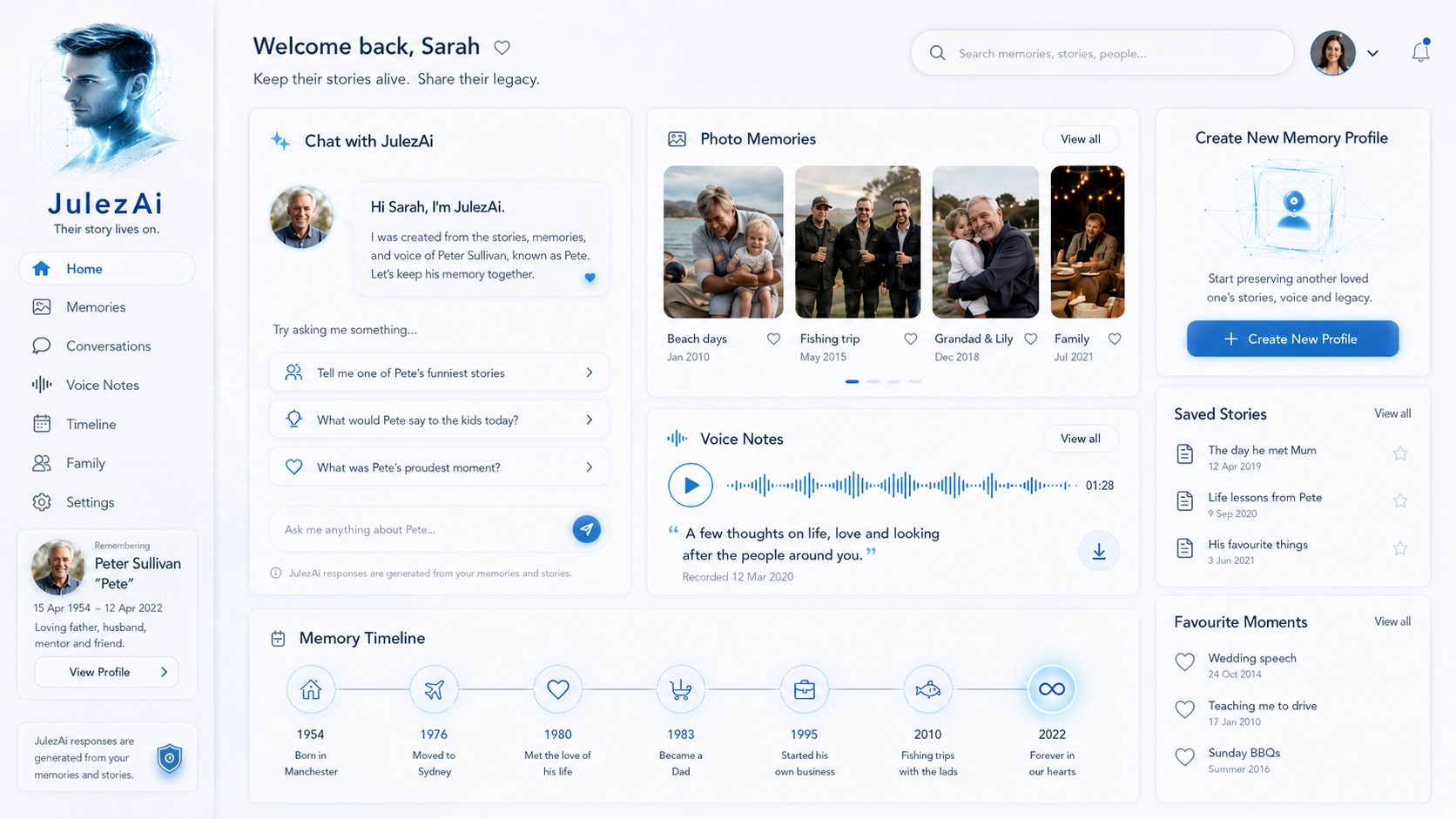
JulezAi is an R&D exploration of what it might mean to treat a personal archive as an interface rather than a folder. The idea is not simply to store more material. It is to help people navigate documented stories, memories and voice while keeping the relationship between an answer and its source visible.
From passive archive to navigable memory
Most personal archives require prior knowledge. Someone has to remember that a particular story exists, know which relative told it and understand where the recording or photograph was stored. When that person is no longer available, the archive can become difficult to interpret even if nothing has been lost.
A more navigable archive could offer several routes through the same material. People might browse by person, place, theme or period of time. They could move from a photograph to the story attached to it, from a name to the relationships that explain it, or from an event to different recollections of what happened.
Questions could become another form of navigation. Someone might ask, “Why did the family move to this town?” or “Which stories mention the old shop?” The useful response would not be a model improvising a satisfying narrative. It would be a source-backed route into relevant recordings, messages, documents and attributed recollections.
This is where AI may contribute something more interesting than automatic description. It can help connect language across an archive, identify related material and create useful paths through information that was never organised for future search. The product work lies in making those paths understandable and preserving the distinction between what was documented, what was remembered and what the system inferred.
The memory provenance ladder
JulezAi needs a clear way to describe how close any output is to the original archive. We call this framework the memory provenance ladder. It has four visibly different layers.
1. Source material
Original photographs, recordings, messages, letters and documents form the first layer. They are the archive evidence. The system may organise, transcribe or index them, but it should preserve a route back to the original item and the information known about where it came from.
2. Contributed memory
Family members or friends may add recollections, descriptions and context. These contributions can make a photograph meaningful or explain a relationship that the source material alone cannot. They should be attributed to the contributor rather than presented as neutral historical fact.
3. Model interpretation
The system may produce summaries, suggest connections or answer questions from the available archive. These outputs are interpretations derived from source material and contributed memory. They should identify their supporting material and make uncertainty visible where the archive is incomplete or conflicting.
4. Generated expression
New wording or voice sits furthest from the source. Generated expression may help present or navigate material, but it must never be shown as an original recording, direct quotation or settled historical fact. Its generated status should be visible at the point where someone encounters it.
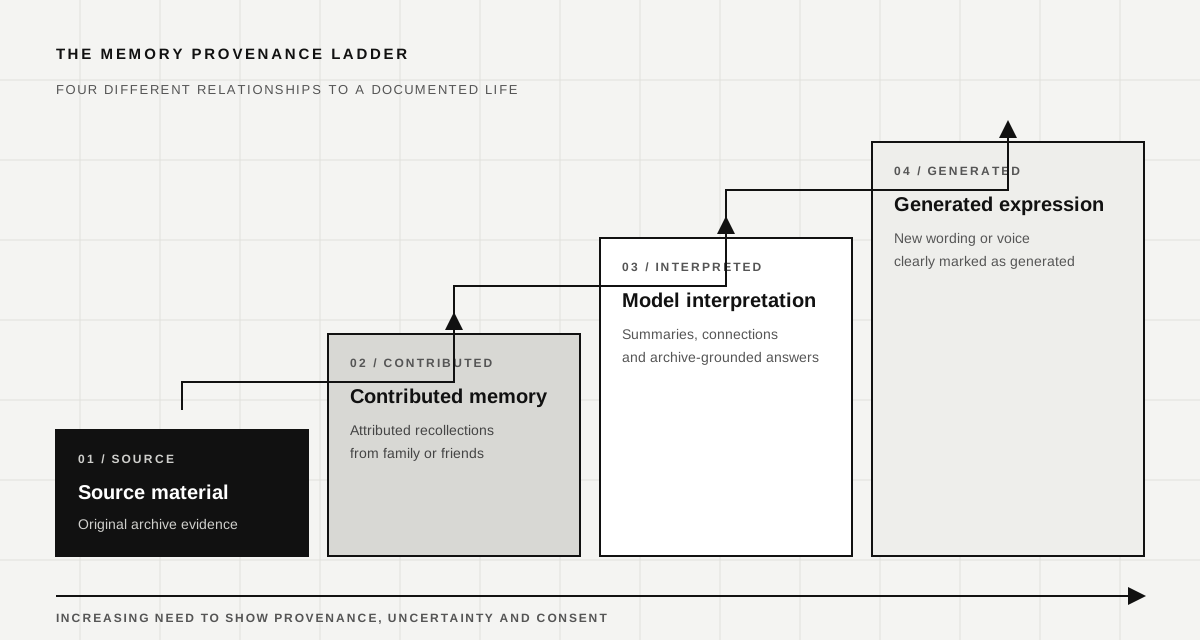
The closer the system moves from source material toward generated expression, the more clearly provenance, uncertainty and consent need to be shown.
A fluent answer is not the same thing as a remembered fact.
Family memory is plural
Families rarely hold one complete, consistent account of a life. Two people can remember the same event differently. A story can acquire new emphasis as it passes between generations. Dates may be uncertain, motives disputed and relationships understood from incompatible points of view.
A memory archive should not erase those differences to produce a clean biography. It can preserve multiple accounts, identify who contributed each one and show where recollections align or diverge. A question may sometimes deserve several attributed answers rather than one canonical response.
Beyond the memorial page
The opportunity extends beyond creating a richer memorial page. A well-structured memory archive could help families preserve oral history before its context disappears, explain relationships that are difficult to capture in a family tree and surface stories that would otherwise remain inside one person’s recollection.
It could connect an interview with the photographs being discussed, or let someone browse every contribution associated with a place. A grandchild could discover how different relatives described the same business, journey or tradition. Future family members could understand not only that an event happened, but why contributors believed it mattered.
Voice needs visible boundaries
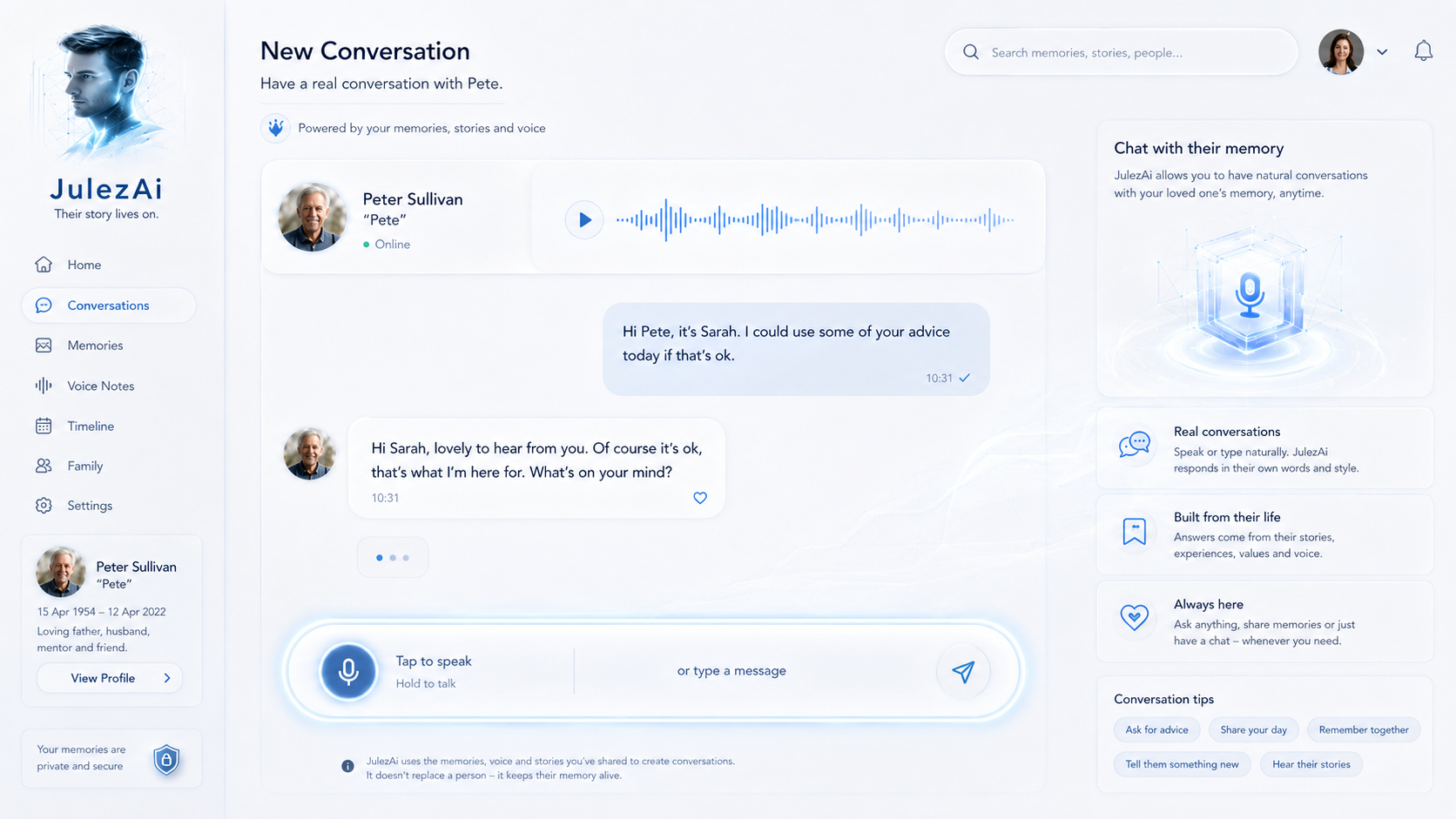
Original recordings, generated speech and quoted memories are different categories. Generated speech creates new audio, even when it resembles a documented voice or speaks words grounded in the archive. A quoted memory may be another person’s recollection of what was said. The interface must make these categories distinguishable rather than allowing them to blend into one apparently authentic voice.
Consent to store audio is not automatically consent to generate new speech. The product would need to record relevant permissions, communicate how voice is being used and support an archive that can remain useful without generated voice at all.
An interface for memory, not imitation
JulezAi does not recreate consciousness or bring anyone back. It cannot reconstruct the private inner life behind an archive, and it should not present generated language as proof of what a person would think or say.
This R&D is partly about discovering a new interface for human memory. The work combines retrieval, provenance, contribution, permissions and interaction design because navigating an archive is not solved by generation alone. If those elements can work together, the result could help families carry more than files from one generation to the next. It could help them carry the relationships and explanations that make those files meaningful.
The opportunity is not to build a machine that pretends to be someone. It is to build a better way for human memory to remain navigable.
Related products
Could this help your organisation?
Tell us about the challenge or idea you are exploring.
Talk to us