From Conversation to Action: Designing Meeting Intelligence That Preserves Context
Research / BuildingA meeting summary is useful. A searchable memory of what was actually said, decided and left unresolved is much more valuable. FireTaker is an exploration of that difference.
About this research
A summary optimises for now
A summary optimises for now; a memory system optimises for later.
The harder product problem begins days or months afterwards. A decision remains in a task list, but the reason behind it has faded. An action has an owner, but nobody remembers which condition shaped the commitment. An unresolved question disappears because it did not fit neatly under “decisions” or “next steps.” Someone joining the work later has to reconstruct intent from fragments.
This is context decay: the source still exists, but the relationships among evidence, interpretation and later action have weakened. Meeting intelligence becomes more valuable when it helps people recover those relationships.
FireTaker remains in active pre-release development. Building it has made this distinction practical.
The Meeting Memory Stack
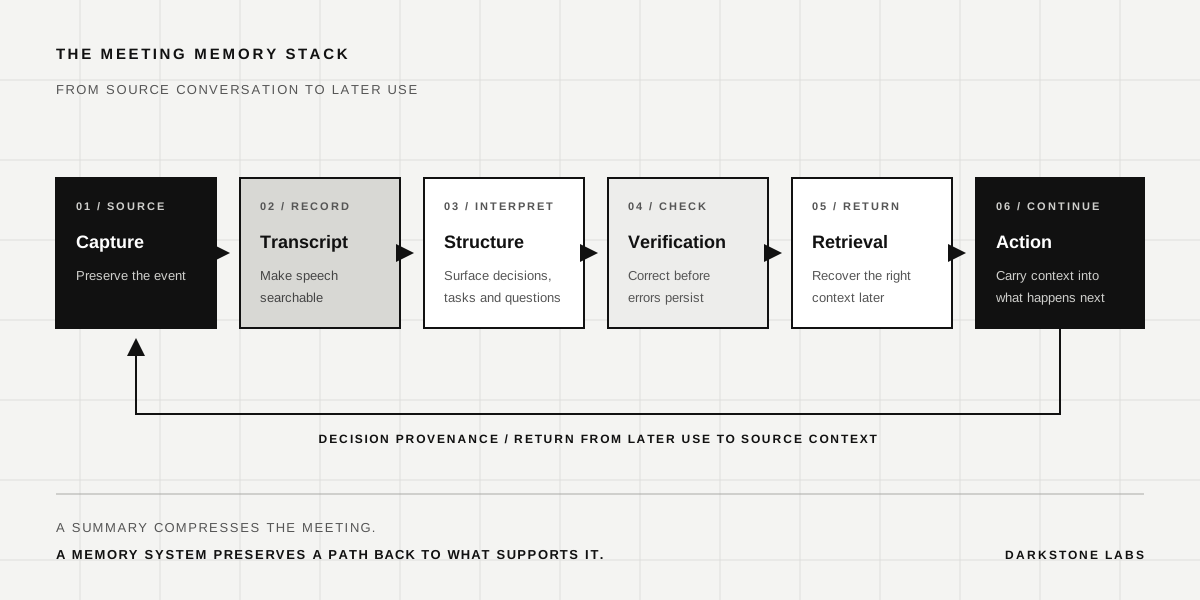
We think about that product problem through six connected layers: Capture → Transcript → Structure → Verification → Retrieval → Action. We call it the Meeting Memory Stack.
1. Capture
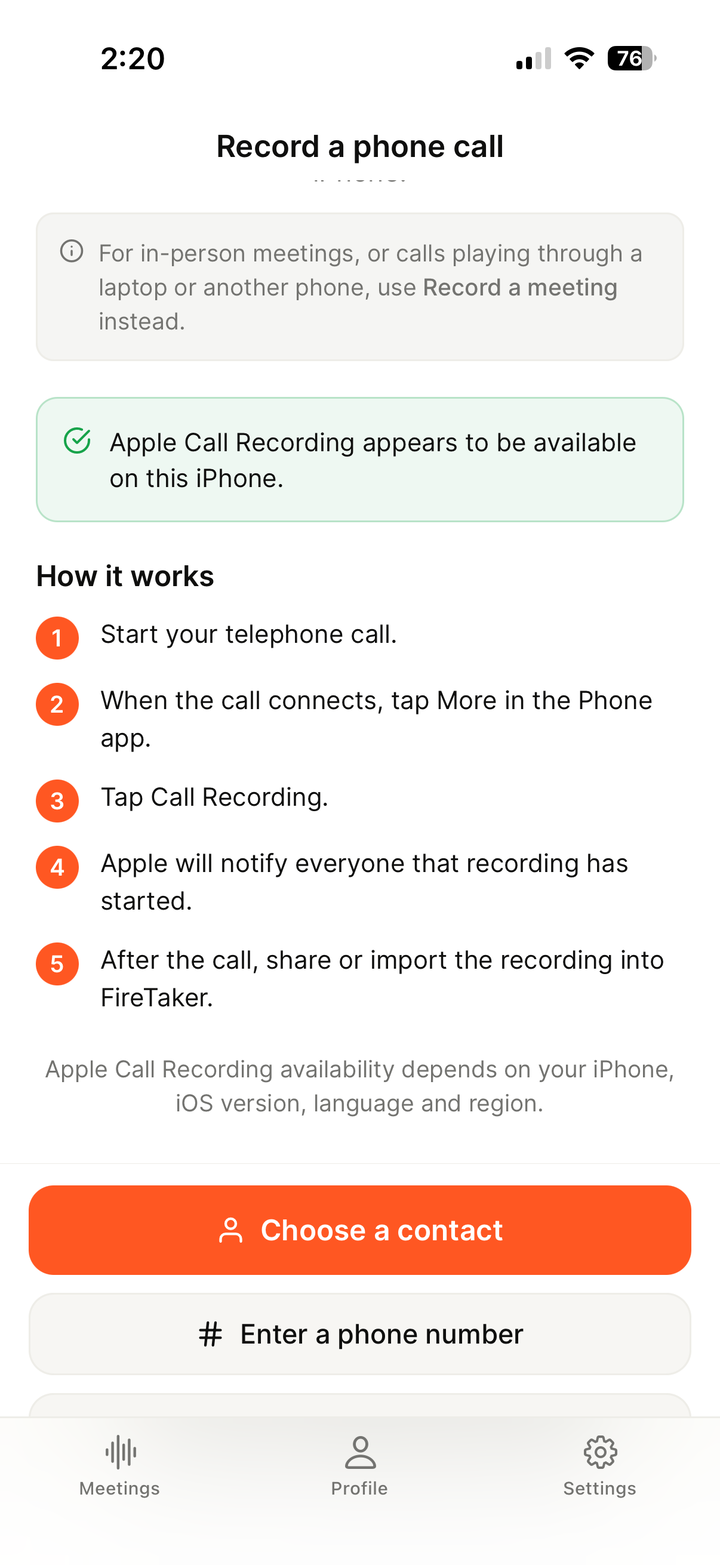
Capture preserves the source event through recording or import. It establishes the material that later outputs refer back to. Its limit is obvious but important: a recording is not automatically usable memory. Audio can be incomplete, consent may be unclear, and an hour-long file is expensive for a person to inspect.
2. Transcript
Transcription turns speech into searchable text. It makes a meeting easier to scan, quote, translate and connect to timestamps. But a transcript remains an imperfect representation. Names are misheard, speakers can be confused and punctuation can change meaning. Searchability should not be mistaken for accuracy.
3. Structure
Structure identifies useful forms inside the conversation: summaries, decisions, open questions and tasks. This is where model interpretation can reduce substantial work. It is also where compression becomes consequential. An extracted decision may omit the qualification that made it acceptable; an apparent task may have been only a suggestion.
4. Verification
Verification gives people a way to inspect and correct the interpreted record. Playback, timestamps, editing and clear links to surrounding context help someone decide whether the generated structure is supported. Verification does not require reviewing every sentence. It makes review possible where the consequence or uncertainty warrants it.
5. Retrieval
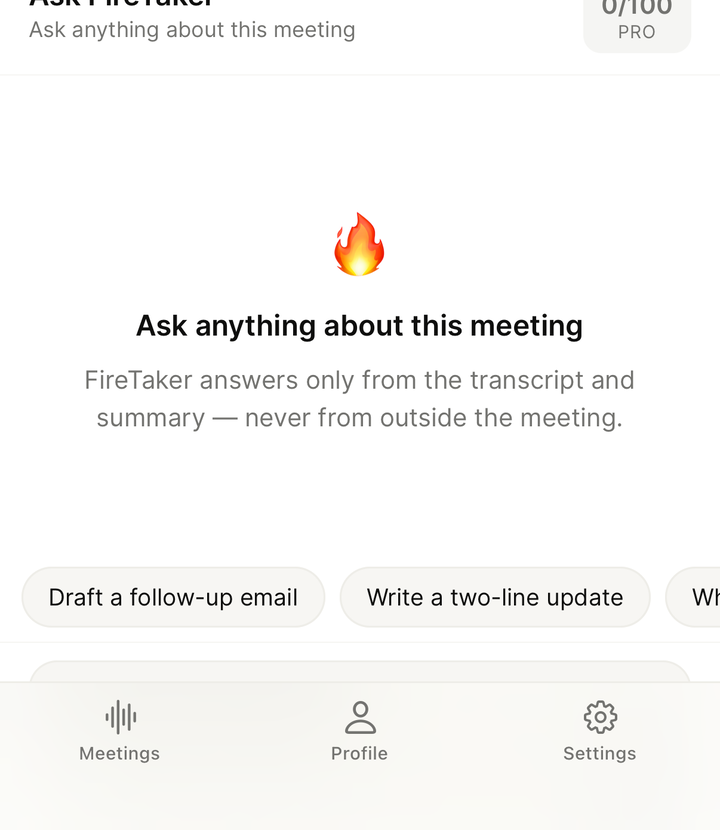
Retrieval lets people return through search, calendar and history, or ask a meeting-specific question through Ask FireTaker. The useful unit is not merely an answer. It is an answer connected to the meeting, relevant passage and available source context. Retrieval cannot recover information that was never captured, and it should not disguise a missing basis with fluent language.
6. Action
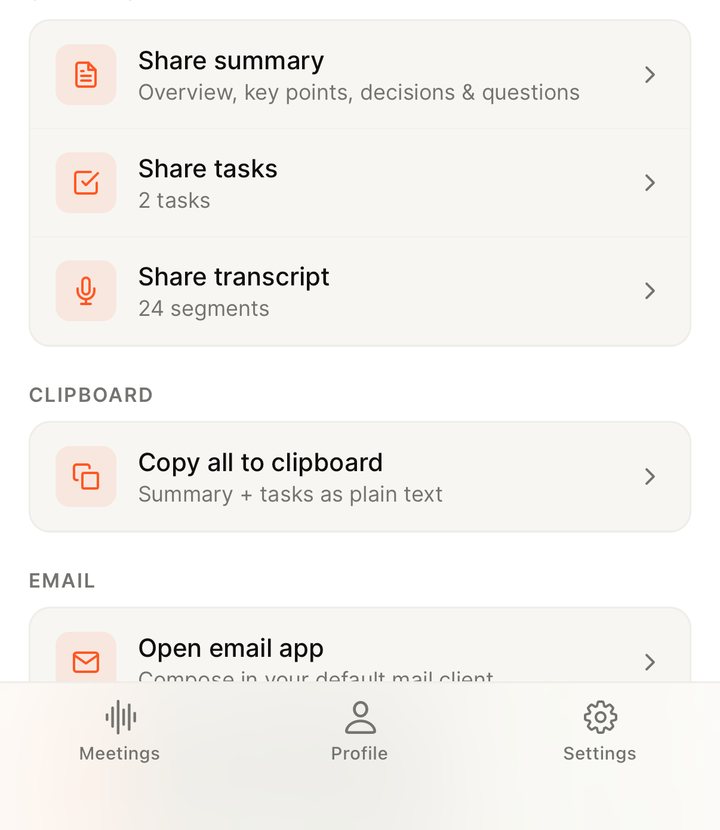
Action carries meeting memory into what happens next: following up, sharing a record, revisiting an open question or acting on a confirmed task. This layer creates value only when the context survives the handoff. An action detached from its provenance can become an instruction nobody knows how to reassess.
Compression is not preservation
Summaries are intentionally lossy. That is why they are useful. They remove repetition, side discussions, hesitation and detail so a reader can understand the meeting quickly.
Loss becomes a problem when the summary replaces the source. A concise paragraph can flatten disagreement, remove sequence and turn a tentative idea into an apparent conclusion. Even an accurate summary cannot anticipate every question someone will ask later.
A meeting-memory product should therefore keep transcript, playback, search and correction available rather than treating generated structure as the source of truth. The summary provides orientation. The transcript provides searchable detail. Playback preserves wording, tone and sequence where they matter. None is sufficient alone.
Translation illustrates the same principle. Making a meeting accessible in another language can expand who can use the record, but translation is another interpretive layer. The original language and source should remain reachable when precise wording affects the meaning.
Decision provenance
Decision provenance is the ability to move from a later action, decision or answer back toward the evidence that supports it.
The path does not need to claim perfect causality. Meetings are messy, and decisions may develop across several conversations. It should make the available basis inspectable: the source meeting, timestamp, transcript passage and surrounding context. That allows someone to understand the record without accepting a generated extraction on authority.
Open questions are part of operational memory
Most meeting software privileges what appears settled. Decisions and tasks fit into structured fields; uncertainty is harder to package.
But operational memory is not only what was decided. It is also what remains uncertain. An open question may explain why an action has not started, what evidence the team still needs or which risk prevented a commitment. If it disappears from the record, later users may interpret a deliberate pause as oversight.
Open questions deserve first-class treatment alongside decisions and tasks. They should remain visible, searchable and available for later review without being converted into false conclusions. Closing one should preserve enough context to understand how the uncertainty was resolved.
Correction compounds over time
An early error can travel. A misspelled name in a transcript can affect search. A wrongly extracted task can appear in a summary. A mistaken decision can later be returned through question-answering as if it were established fact.
That is why editing and correction are not cosmetic controls. Correcting the underlying record protects later retrieval. Where appropriate, the product should make clear whether a correction changes the transcript, an interpreted structure or both, so users understand what future search and answers will rely on.
Correction also reveals recurring weaknesses. Patterns can show where transcription struggles with vocabulary, where extraction confuses discussion with commitment, or where the interface fails to provide enough context for review. Those signals are useful product evidence during active development.
Memory has to fit the work
FireTaker’s implemented direction brings these layers together over time. Recording or import establishes the source. Transcription, summaries and extracted decisions, open questions and tasks create usable views. Search, calendar and meeting history help people return. Playback and editing provide routes for inspection and correction. Ask FireTaker offers a question-based route into a specific meeting rather than treating every query as detached from its record.
Secure sharing and retention controls matter for the same reason. A meeting record is useful only if the right people can access it and the organisation can decide how long it should remain available. Sharing without a clear boundary weakens confidence in capture. Indefinite retention by default can make people less willing to use the system for real conversations.
Consent, retention and sharing are therefore product behaviour, not generic compliance language. People need to understand when a meeting is being recorded, what is retained, who can receive access and what happens when material is deleted. Those choices shape whether meeting memory can fit ordinary work.
Build for the return visit
The first encounter with meeting intelligence usually happens immediately after the call. The more revealing moment is the return visit: when someone searches for an old commitment, checks the words behind a decision, corrects a persistent error or asks what remained unresolved.
The value of meeting intelligence is not that it remembers everything. It is that it helps people recover the context that still matters.
Related products
Could this help your organisation?
Tell us about the challenge or idea you are exploring.
Talk to us