The Human Loop Is Not a Limitation
Human review is often treated as temporary friction on the road to full autonomy. In well-designed AI systems, it can be the control surface that makes useful autonomy possible — and the feedback loop that improves the product.
Human attention is a control surface
Human attention is a control surface.
That is a more useful way to think about the human loop than treating every review step as temporary friction on the road to full autonomy. A person in a workflow is not automatically evidence that the technology is unfinished. Their involvement may be the mechanism that sets authority, catches important mistakes, supplies missing context and helps the product learn from real use.
Autonomy is a design choice, not the destination. The right level depends on the work, the consequence of being wrong and how easily the result can be checked or reversed. Removing a person can make a process faster. It can also remove the judgement that made the process reliable.
The product question is therefore not simply, “Can the AI do this alone?” It is, “Which operating mode produces the best outcome for the people and organisation involved?”
Three deliberate operating modes
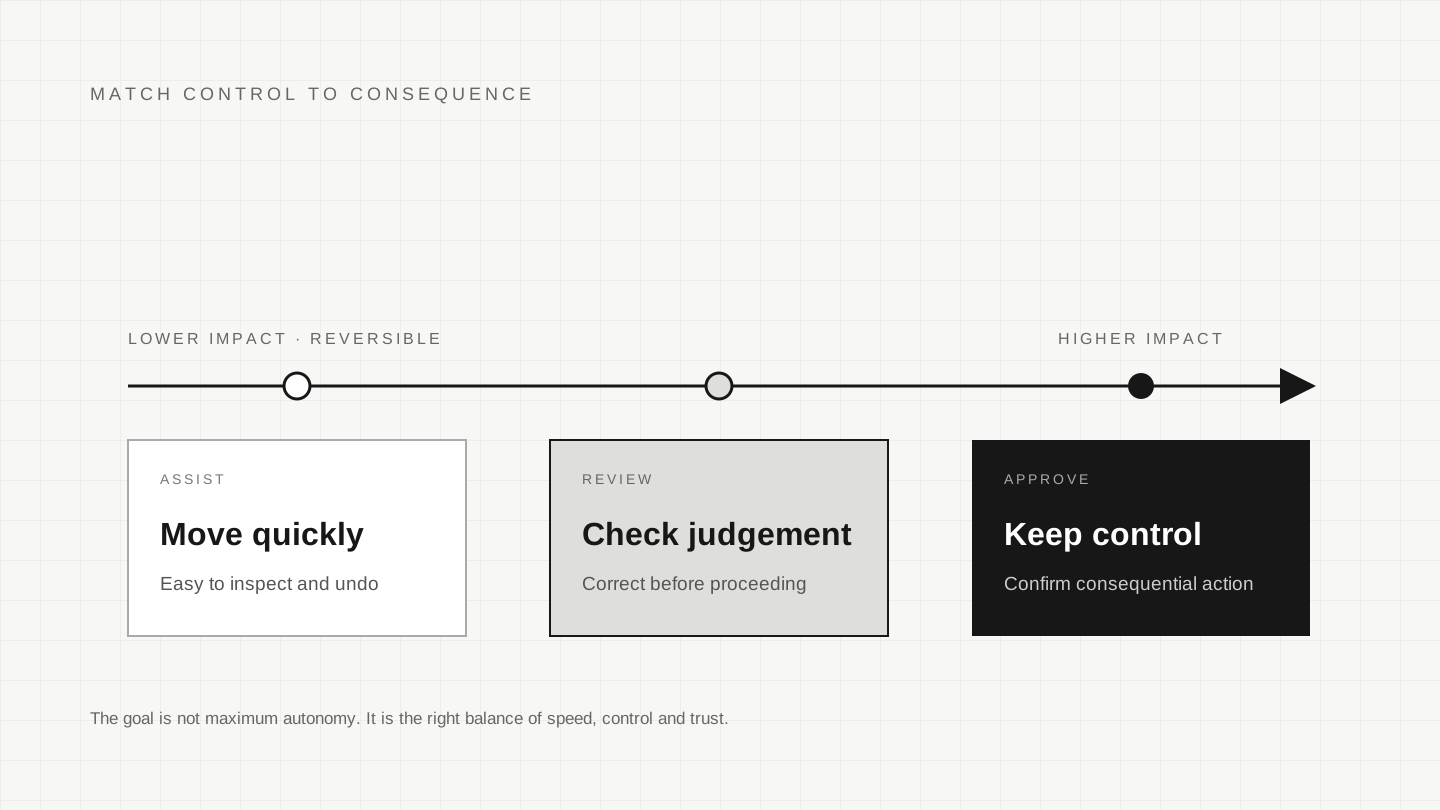
A useful AI product can move between three modes rather than treating autonomy as an all-or-nothing setting.
- Automate for low-consequence, reversible work. Organising notes, suggesting tags, formatting information or preparing an internal draft can often happen immediately when mistakes are visible and easy to undo.
- Review when a person should check context, evidence, tone or judgement. A sales message, meeting summary, customer response or proposed record update may be useful work for AI to prepare, while a person decides whether it is accurate and appropriate.
- Approve when a consequential action should wait for someone with the right authority. Financial changes, access decisions, legal commitments or important external communication should not happen merely because a model produced a plausible recommendation.
These modes should be chosen at the level of the action, not assigned permanently to an entire product. The same system might automate transcript formatting, ask for review before sharing a summary and require approval before changing an account or sending a binding instruction.
Review debt
Human involvement can become weak when it is used carelessly. We call this review debt: the accumulated cost of asking people to approve too many low-value decisions.
Every unnecessary confirmation spends attention. When users repeatedly see harmless, obvious or consistently correct suggestions, they learn that the approval step carries little information. Clicking through becomes routine. Eventually the same habit reaches an action that genuinely deserves scrutiny.
Review debt is not only an efficiency problem. It reduces the quality of the control itself. A workflow with one hundred approvals may be less safe than one with ten well-chosen interventions because the important moments are buried inside administrative repetition.
Human attention should therefore be spent where judgement actually matters. Products should remove reviews that provide no meaningful choice, combine related decisions where appropriate and make higher-consequence interventions visibly different from routine corrections.
What a review screen needs to answer
A useful review screen should quickly answer:
- What is the AI proposing?
- What evidence supports it?
- What happens if I approve it?
- Can it be reversed?
If a reviewer has to reconstruct the source, search for the affected record or guess what the button will do, the product has transferred work rather than supported judgement. The interface should make the decision legible before asking someone to take responsibility for it.
Corrections are product evidence
Corrections are not just cleanup. They are evidence about where the product is weak.
An edited summary may reveal a model-interpretation problem. A rejected recommendation may point to missing or outdated context. A repeated escalation may expose a workflow rule that does not match operational reality. A reviewer who constantly leaves the screen to find source material may be revealing an interface-design failure.
The product should distinguish among these causes. Treating every correction as “the model was wrong” hides where improvement is actually needed. Sometimes the better intervention is a clearer input, stronger retrieval, a changed rule or a more useful review interface rather than a different model.
Accumulated edits, rejected suggestions and intervention patterns can become product-specific learning even when the underlying model is widely available. They show how a particular workflow behaves, where users disagree with the system and which boundaries matter in practice. Used carefully, that evidence can improve evaluation, product decisions and where automation is introduced next.
Design the handoff, not just the AI
Teams often spend significant effort refining what the model produces and much less on the moment when a person must act on it.
Show relevant source context. Highlight what changed. Separate observed facts from generated interpretation. Make uncertainty visible without forcing the user to decode technical scores. Give people a direct way to edit, reject, escalate or defer.
Do not make users trust the model’s own explanation of why it is right. A fluent justification is still generated output. Where evidence matters, the interface should connect the reviewer to the underlying document, record, calculation or conversation so they can make an independent judgement.
A good handoff also preserves continuity. If someone corrects a name, rejects a proposed action or adds missing context, that decision should carry into the next relevant step rather than disappearing after approval.
Stronger controls can enable more autonomy
There is an apparent paradox in AI product design: stronger control points can enable more useful autonomy.
When a system knows which actions it may take, what evidence is required, where authority changes and when it must stop, teams can safely allow it to do more inside those boundaries. Without clear stopping points, every action feels risky. With them, routine work can move quickly while exceptional or consequential cases receive attention.
The aim is not to maximise approvals or minimise them. It is to place control where it protects value, then let the rest of the workflow operate with as little friction as the work allows.
Measure the quality of the loop
Human-loop performance should be measured as part of the product, not treated as an anecdotal safeguard. Useful measures include:
- correction rate;
- reasons for correction;
- review time;
- escalation patterns;
- approvals routinely accepted without inspection; and
- where authority can safely expand.
These measures need interpretation. A falling correction rate may indicate improvement, or it may mean reviewers have stopped paying attention. Fast approval may reflect a clear interface, or review debt. The product team should examine patterns alongside real cases and user behaviour.
The goal is a loop that becomes more selective and more useful over time: routine work moves with less interruption, meaningful interventions become easier to recognise, and evidence supports any expansion of authority.
The best human loop is not a brake on autonomy. It is the mechanism that lets autonomy expand without outrunning trust.