
From Probabilistic Models to Reliable Business Systems
A practical framework for turning powerful AI models into dependable real-world software.
Executive summary
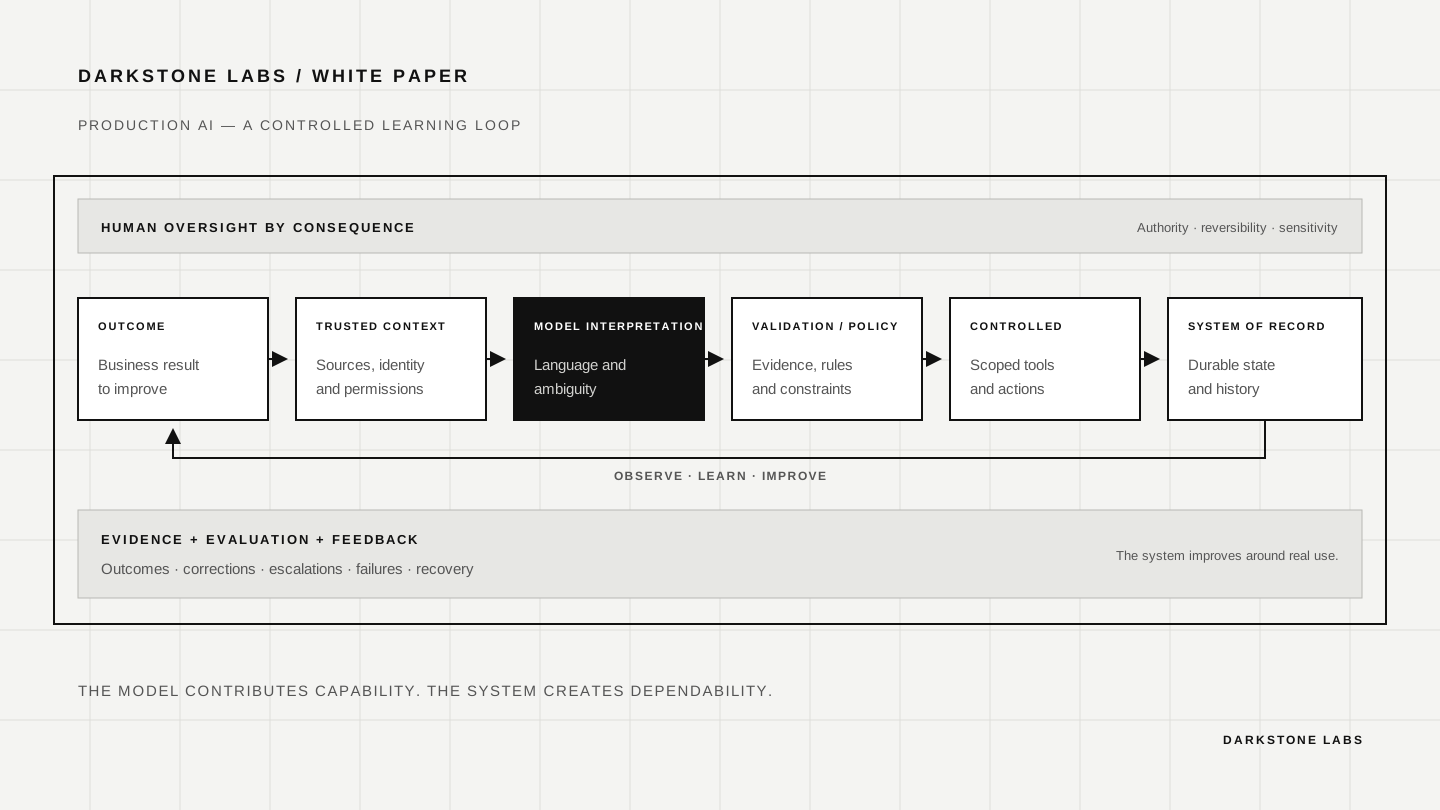
Putting a capable model inside a product is increasingly straightforward. The harder production work is deciding what context it receives, what it may do, how errors are handled and whether the complete workflow creates measurable value.
The model is not the product. The system is the product.
Clear authority, evidence and recovery do not make AI timid. They allow teams to give it meaningful work without treating a language model as the database, policy engine, security boundary and final decision-maker at the same time.
1. The real shift is from model access to system advantage
As model capability becomes broadly accessible, model choice alone is less likely to distinguish a product. Two teams can use the same underlying model and produce very different results.
Differentiation can come from domain context, workflow design, integrations, permissions, product experience, feedback data and operational learning. These are not automatic or guaranteed advantages. They matter when they make a workflow more useful, dependable or economical for a specific user.
Repeated use can deepen that product knowledge. Corrections can improve evaluation, failures can expose missing controls, and user behaviour can reveal which context and interfaces matter. The relevant capability is not merely adopting a model, but learning how to make it useful in a real system.
2. Interpretation and execution are different jobs
AI is unusually good at working with ambiguity. It can interpret a loosely written request, extract intent from an email, summarise a long meeting, compare conflicting documents or infer what information a user is probably looking for. Those are valuable capabilities precisely because the input is messy.
Execution is different. Moving money, updating a customer record, reserving a scarce resource, changing a legal status or sending a message on someone’s behalf requires explicit rules, permissions and a durable record of what happened.
The cleanest boundary is therefore often this: let AI interpret; let the application control authority.
Take a customer asking for a refund. A model can identify the account mentioned, understand the complaint, extract the reason and propose a response. The application should verify the account, retrieve the actual transaction, apply refund policy, calculate any permitted amount, check the requester’s authority and decide whether approval is required. The model contributes understanding. The system owns the action.
A practical rule of thumb
Two questions help place the boundary: how ambiguous is the input, and how much operational impact could the action have? This is a rule of thumb, not a universal law.
- Simple input, low impact: Normal automation is often enough.
- Ambiguous input, low impact: This is often a good candidate for AI-led automation.
- Ambiguous input, significant impact: AI can interpret the request, while validation or authorised approval controls the action.
- Simple input, significant impact: Execution should usually remain in conventional software, with AI assisting where useful.
3. Validation is about meaning, not just format
Structured outputs help turn model responses into something software can work with. Schemas, permitted values, required fields and citations reduce unnecessary variation and make failures easier to detect. But passing a schema is not the same as being correct.
A model can return a perfectly valid JSON object containing the wrong account number. It can cite a paragraph that exists but does not support the conclusion. It can produce a confidence score that looks precise without being a reliable probability.
Production validation therefore needs layers. Check structure first. Then check whether referenced records exist, whether permissions allow access, whether calculations agree with conventional software, whether cited evidence actually supports the claim and whether the proposed action fits business policy. If the answer remains ambiguous, the correct outcome may be clarification, a safer fallback or human review—not another blind retry.
This is where good AI product design becomes less about forcing an answer and more about knowing when not to pretend certainty exists.
4. Human oversight should scale with consequence
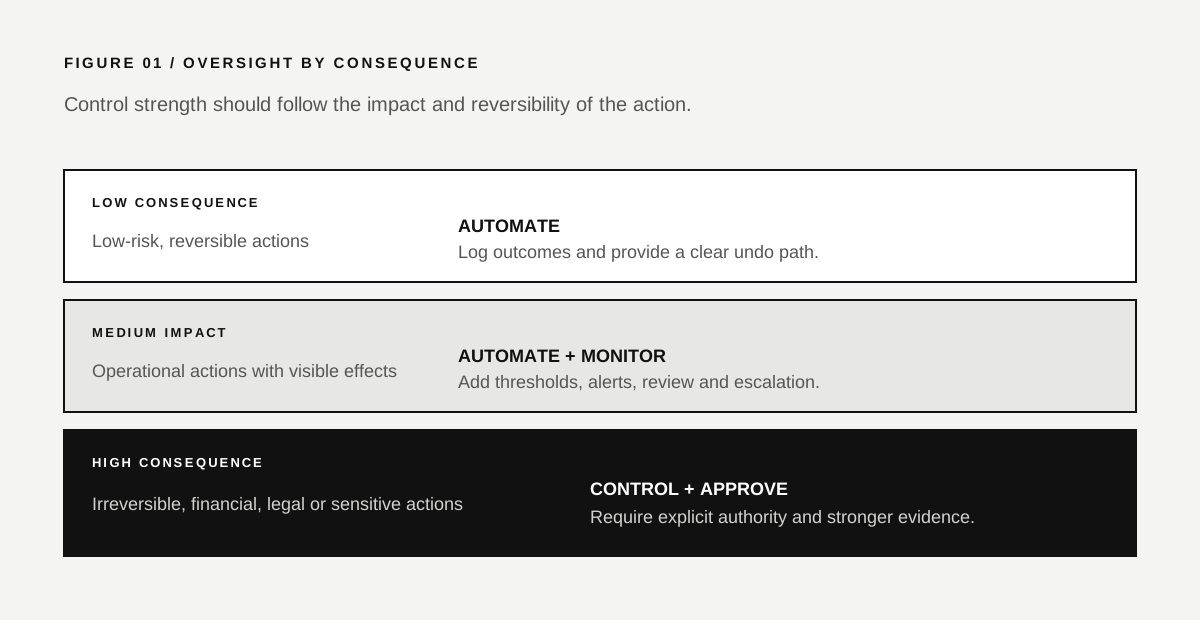
“Human in the loop” is too vague to be a design principle. The useful question is: what could happen if this action is wrong, how reversible is it, and who has authority to accept that risk?
Low-consequence work can often run automatically. Formatting notes, suggesting tags, drafting internal text or organising information may need little more than logging and an undo path.
Medium-consequence actions can often automate with monitoring: updating a routine workflow state, preparing a follow-up, prioritising a queue or creating a draft record. Here the system should expose history, thresholds, alerts and a clear route to escalation.
High-consequence actions deserve explicit control. Financial transfers, legal commitments, deletion of sensitive records, major account changes or actions affecting someone’s rights should require stronger evidence, tighter tool permissions and, where appropriate, an authorised person before execution.
The key is not simply adding a human approval button. Review only works when the reviewer can see the source information, understand what the AI proposed, recognise uncertainty and intervene without fighting the interface.
A practical control model should consider at least four dimensions: consequence, reversibility, data sensitivity and authority. A low-value action involving highly sensitive data may require stronger controls than its financial impact suggests. A reversible action can usually tolerate more automation than one that cannot be undone.
This is also how useful autonomy grows. Start with bounded authority, observe real behaviour and expand what the system can do only when evidence supports it.
5. Better context can matter more than a better model
Many disappointing AI systems are not suffering from an intelligence problem. They are suffering from an information problem.
The model receives an outdated policy, the wrong customer record, a duplicated document, incomplete product data or information the user should never have been able to retrieve. A more capable model cannot reliably repair a broken source of truth.
Production retrieval therefore needs more than semantic similarity. The system should know where information came from, how current it is, which source is authoritative and whether the person making the request is entitled to see it.
Three questions are worth asking before almost any enterprise AI project:
Can we identify the source we trust?
Can we enforce who is allowed to access it?
Can we tell when it has changed?
If the answer is no, fixing the information layer may create more value than changing models.
6. Failure is part of the product
Production systems fail. Models time out. APIs become unavailable. A source document disappears. A user gives contradictory instructions. An integration accepts a request but does not complete it. The question is not whether failure can be eliminated; it is whether failure has been designed.
Good failure design preserves intent and gives the user a next step. Work that can wait can be queued. Transient technical failures can be retried within sensible limits. Repeated failures should move to review rather than looping forever. When generation is unavailable, the product may fall back to search, conventional rules or manual processing. Most importantly, the system should preserve the user’s work instead of forcing them to begin again.
Retries need a business lens as well as a technical one. Sending the same API request twice can create two records, two emails or two payments. Calling a model twice can produce two different interpretations. A safe retry is not automatically a safe business action.
7. Security is really about capability control
AI security is often reduced to prompt injection. The deeper issue is what a model can see, what it can influence and what it is allowed to do when untrusted language enters the system.
A model that can only summarise a document presents a different risk from a model that can search internal systems, send messages, modify records and trigger financial actions. Tool access turns language into capability.
That makes least privilege a practical AI design principle. Give the workflow only the tools and data it needs. Keep permission checks outside the model. Separate users and workspaces. Treat retrieved content as potentially untrusted. Require approval before sensitive execution. Record important tool calls and decisions without unnecessarily duplicating sensitive data into logs.
Security should therefore be designed around capability boundaries, not just better prompts. The safest instruction in the world is a weak control if the model still holds credentials that allow an inappropriate action.
8. Measure the system by the work it improves
A model can produce an impressive answer and still create a poor product. Production measurement should begin with the workflow outcome, not with how intelligent the output appears.
Choose one primary business result for the use case. That might be time to complete a case, proportion of enquiries resolved correctly, meetings converted into usable follow-up, reduction in manual handling, response rate in an approved outreach workflow, or the number of corrections required before an output becomes useful.
Then measure the costs around it: review time, escalation, latency, failed actions, recovery effort and user abandonment. If AI saves five minutes of drafting but creates ten minutes of checking, the workflow has not improved.
Technical evaluations still matter. Retrieval quality, extraction accuracy, groundedness, tool-selection accuracy and unsafe behaviour should be tested deliberately. But they are diagnostic measures inside the product. The commercial question remains whether the complete system helps someone achieve a valuable outcome more effectively.
Corrections, failed workflows and escalations can reveal whether context, interface, validation or policy needs to improve. That learning is more valuable than treating a prompt as a finished asset.
9. What building products has taught us
Darkstone Labs develops products across different problem spaces. Their model requirements vary because the work, constraints and consequences vary.
Ploky is deliberately illustrative. High-stakes event scheduling can look like an obvious AI problem because it is complex. But room capacity, time slots, blackouts, availability and priority rules are hard constraints. The core scheduler is rule- and priority-based, not AI-powered. Complexity alone is not a reason to introduce a probabilistic decision-maker.
FireTaker sits at the opposite edge. Human conversation is unstructured, contextual and difficult to search. AI adds genuine leverage in transcription, summarisation, questions, translation and extracting decisions or tasks. Yet the useful product is bigger than those model calls: recording, playback, editing, search, retention, sharing and account controls turn model capability into a usable system.
JulezAi raises a different class of question. When software works with personal memories and voice, technical capability is only part of the design. Source material, consent, representation, boundaries and the ability to distinguish memory from generated interpretation become central to whether the experience deserves trust.
BillTiger brings the same principle into a consumer workflow. AI can help explain complicated information in plain English and surface possible actions, but useful assistance still depends on accurate bill details, clear assumptions and keeping the user in control of real financial decisions.
These products do not imply that one architecture solves everything. They show why model placement is a product decision: the useful role of AI changes with the problem, and so do the controls around it.
Commercial value can accumulate in domain knowledge, proprietary workflows, trusted context, integrations, evaluation data, user relationships and the speed at which a team learns to turn new model capability into useful products. Applied R&D matters when it shortens that learning cycle rather than existing as research theatre.
10. A five-stage path from idea to production
The strongest first AI workflow is rarely the one with the most futuristic demo. It is usually a repeated problem where ambiguity creates meaningful manual work, the outcome can be measured, reliable source information exists and the consequences are controllable.
Stage 1 — Choose the outcome, not the technology
Start with the job that needs improving. What takes too long? Where do people repeatedly interpret messy information? Which outcome would make the project economically worthwhile? If conventional software already solves the problem cleanly, use conventional software.
Stage 2 — Draw the authority boundary
Decide what the model may interpret or propose and what the application must validate or execute. Identify the systems of record, hard rules, permissions, irreversible actions and points where human authority is required.
Stage 3 — Prototype against reality
Use representative data, awkward edge cases and the people who actually perform the work. Test conflicting records, incomplete inputs, ambiguous requests and permission boundaries—not only ideal examples. A prototype should discover where the concept breaks, not merely prove that it can work once.
Stage 4 — Instrument, constrain and recover
Add structured outputs, evidence checks, identity, scoped tools, workflow state, logging, evaluation, fallbacks and consequence-based review. Design what happens when the model is uncertain or a dependency fails. Decide what the system will refuse to do.
Stage 5 — Expand authority only on evidence
Deploy in a bounded scope and measure the business outcome. Review corrections, escalations and failures. Improve retrieval and interface design before assuming a larger model is the answer. Increase automation only where observed performance, reversibility and consequence justify it.
This path is intentionally iterative. OpenAI’s agent guidance recommends clear use cases, evaluation and layered guardrails; Anthropic’s engineering guidance emphasises simple composable patterns before unnecessary agentic complexity; NIST’s Generative AI Profile reinforces the broader lifecycle point that trustworthiness has to be managed across the system, not bolted on at the model endpoint.
Conclusion
Model access alone is unlikely to remain a durable advantage. Capabilities are spreading quickly, models continue to improve, prices change and new functionality reaches more builders faster than traditional technology cycles suggest.
The durable work sits in products that people can trust and organisations can operate: clear context and authority, useful interfaces, reliable integrations, recovery paths and learning from use.
That is also where we believe the opportunity sits. Once the surrounding system is strong, probabilistic AI can be used more ambitiously—not less. It can handle ambiguity that conventional software struggles with, unlock information trapped in language, coordinate work across tools and create entirely new product experiences. The engineering discipline around it is what makes that ambition usable.
For organisations, the practical starting point is not “Where can we add AI?” It is “Where are people repeatedly doing difficult interpretive work, and what would a better system allow them to do?”
For builders and investors, the question is broader: which teams can repeatedly convert rapidly changing model capability into proprietary products, workflows and learning loops before the underlying technology moves again?
Darkstone Labs is being built around that question.
Organisations evaluating workflows where language, judgement and automation intersect can work with Darkstone Labs to map the workflow, test it against real data and determine whether AI creates enough value to justify production use.
Further reading
- NIST — Artificial Intelligence Risk Management Framework: Generative Artificial Intelligence Profile (NIST AI 600-1)
- Anthropic — Building Effective AI Agents
- OpenAI — A Practical Guide to Building AI Agents
The objective is not to make AI deterministic. It is to build systems that remain dependable even when the AI inside them is not.