AI That Does Something Useful: Moving Beyond the Demo
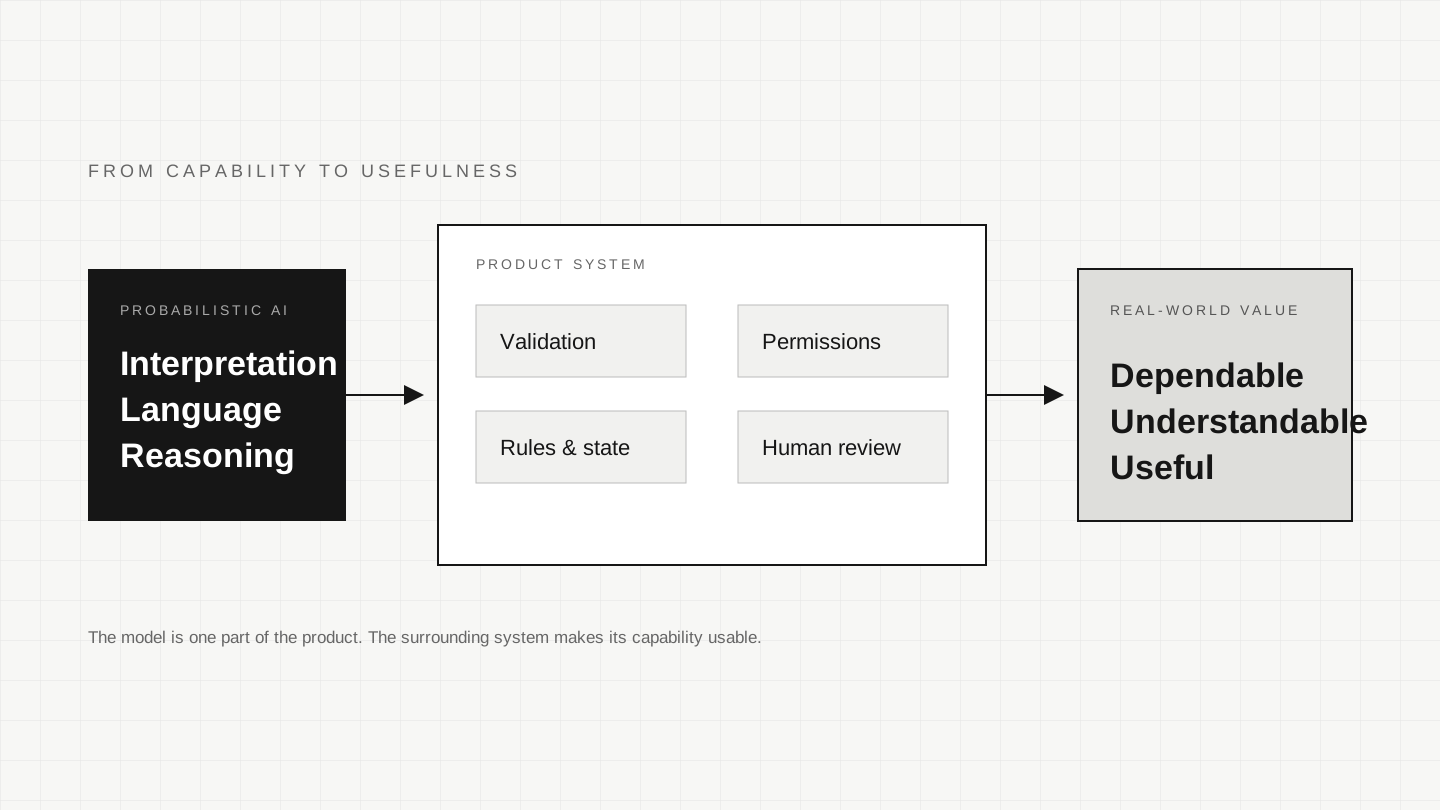
A demo proves that an AI capability is possible. A product has to prove that people will return to it, trust it, recover when it goes wrong and get enough value to change a real workflow.
Capability is only the beginning
A demo proves capability. A product has to prove value.
Demos intentionally simplify reality. They use a clean example, known context and a short path from input to impressive output. That is useful. A focused demonstration helps a team understand what a model can do, gives people something concrete to react to and makes a new product idea easier to explore.
The simplification becomes dangerous only when it is mistaken for completion. The model may summarise the perfect recording, answer a question from a carefully selected document or produce a polished draft from a complete brief. None of that shows what happens when the input is poor, the history is missing, the user returns next week or the connected service fails halfway through the task.
Demo debt
We use the phrase demo debt for the assumptions left unresolved after a prototype looks convincing.
Demo debt can include:
- ideal examples that avoid the difficult cases;
- hidden manual work performed by the team behind the scenes;
- missing recovery states when an input, model response or connected service is wrong;
- absent history, so the product forgets everything between sessions;
- unclear operating costs once real usage, review and support are included; and
- no proof that the feature fits naturally into daily work.
Five practical tests help make that list explicit.
The Job Test — is there a repeated problem worth solving?
A compelling output is not enough. The product needs a recurring job that matters to someone.
Consider meeting summaries. People may admire an accurate summary without needing another one tomorrow. The stronger job is broader: remembering what was decided, finding a commitment later, preparing for the next conversation or turning discussion into follow-up without reconstructing it from scattered notes.
The Job Test asks how often the problem occurs, who feels it and what changes when it is solved. If the answer is occasional curiosity, the feature may remain a useful tool. If the answer is repeated operational friction, there may be a product.
The Context Test — is the right information available at the right moment?
AI features often look intelligent because the demonstration supplies exactly what they need. Products rarely receive that courtesy.
A meeting tool may need the recording, speaker context, account history, previous meetings, project vocabulary and the user’s permissions. Too little context produces generic or incorrect results. Too much creates noise, cost and unnecessary exposure.
The Context Test is not simply whether information exists. It is whether the system can access the right information and history at the moment the user needs it, while preserving ownership and boundaries. A summary that cannot connect to the meeting it came from quickly becomes another isolated document.
The Recovery Test — can the user continue when something goes wrong?
Real recordings contain poor audio, unfamiliar names, interruptions and missing sections. Uploads fail. Transcripts contain errors. A model may misunderstand the most important sentence while sounding confident about the rest.
The Recovery Test asks whether the user can continue. Can they retry an import without losing their work? Can they play the original audio, correct a transcript, reject an extracted action or identify which source produced an answer? If a connected service is unavailable, does the product preserve the request and explain what happens next?
The Workflow Test — does the output lead to the next useful action?
AI products frequently create a new copy-and-paste task. The model produces a useful answer, but the user must move it into the CRM, project tool, email or document where the work actually continues.
For a meeting product, the summary is not the end. A decision should remain connected to its source. An action should have an owner. A follow-up should be editable before it is sent. A question about the meeting should use that meeting’s context rather than begin from zero.
The Workflow Test asks what the output enables next. If the product saves three minutes of writing and creates five minutes of administration, the impressive result has not improved the job.
The Economics Test — is the complete workflow better than what it replaces?
Model cost is only one part of product economics. Latency, review time, failed requests, support, integration maintenance and correction work also matter.
A feature may be technically affordable while remaining operationally expensive. It may save time for one person while transferring work to another. It may increase output volume without improving completion, quality or customer response.
The Economics Test compares the complete workflow with the current alternative. Is the job faster, clearer or more valuable after all costs are included? Does the improvement persist? A credible product case does not require perfect efficiency, but it does require an honest account of where value is created and where cost remains.
FireTaker: from summary to working memory
FireTaker makes the distinction concrete. Summarising a meeting is the demo. It shows that a model can turn conversation into a concise record.
The product value comes from what works together over time: recording or importing audio, searchable history, playback, transcript editing, decisions and actions, meeting-specific questions, retention and sharing. Each capability supports the next moment when someone needs the conversation to be useful.
A user may return to confirm what was promised, prepare for a follow-up or correct a detail before sharing it. The product succeeds when those actions feel easier than searching through recordings, notes, inboxes and memory. The summary matters, but it earns value through the surrounding experience.
Strong AI products become habits, not spectacles
Spectacles create a memorable first reaction. Products create a reliable reason to return.
Habit does not mean constant engagement. It means the product becomes the natural place to complete a recurring job. People know what it remembers, how to correct it and what they can do next. The AI becomes less visible as a performance and more useful as part of the work.
Where companies are actually built
Model access becomes easier to copy as capabilities spread across providers and products. The less visible work is harder to reproduce quickly: understanding a workflow, assembling trusted context, learning from feedback, maintaining integrations, designing clear interactions and reaching the users who have the problem.
None of those elements guarantees an advantage. Together, they can create a product that improves through use and fits its market more closely than a demonstration built around the same model.
This is where companies are actually built: not in the first surprising output, but in the repeated decisions that turn capability into behaviour, reliability and a reason to return.
The demo proves the capability. The product proves the value.