
AI as a Growth System: Rethinking the Sales and Marketing Funnel
AI can do more for growth than generate content. The bigger opportunity is to connect market signals, account research, outreach, CRM memory and commercial learning into a system that helps teams make better decisions repeatedly.
Growth is not a content problem
The easiest way to add AI to marketing is to ask it to produce more: more emails, more posts, more campaign variants, more summaries. That can reduce effort, but volume is not the same as growth.
Most commercial teams already have plenty of activity. What they often lack is continuity. Research sits in one tool. Campaign data sits in another. Sales notes live in CRM. Meeting context disappears into calendars and inboxes. Objections are heard repeatedly but rarely become structured learning. The organisation generates signal everywhere and remembers surprisingly little of it.
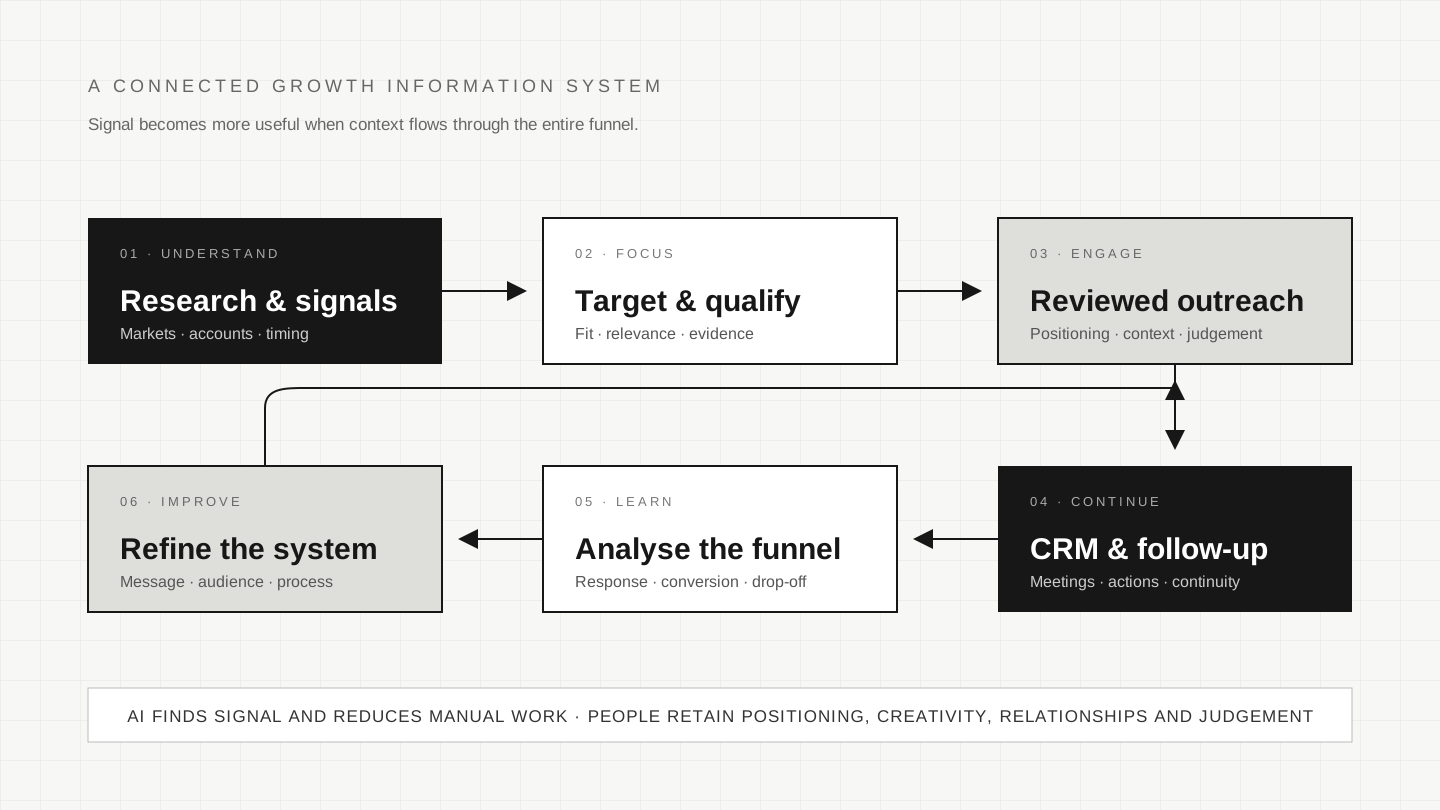
That is where AI becomes more interesting. The opportunity is not a faster content machine. It is a commercial system that can notice signal, preserve context, support judgement, trigger the right next action and learn from what happened afterwards.
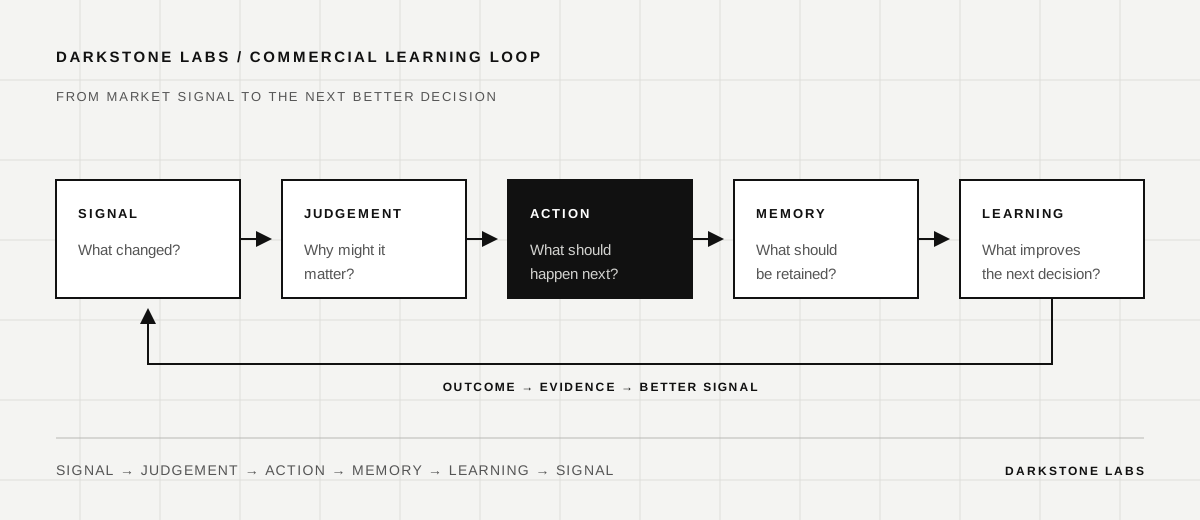
We think of that loop as five connected jobs: signal, judgement, action, memory and learning.
Signal: what changed, and why might it matter?
Useful growth systems start before outreach. AI can help organise messy public and internal information: company announcements, reports, hiring, market moves, CRM history, meeting notes and campaign responses. It can surface changes that may make a conversation more relevant.
But a signal is not intent. A new CFO does not mean a company wants your product. A funding round does not mean it has budget for you. The system should show evidence rather than manufacture certainty: what changed, where it came from, why it may matter and what is still unknown.
Judgement: build a commercial hypothesis
The useful unit of AI-assisted selling is not a lead score. It is a reasoned hypothesis.
Why might this organisation care? Which problem appears relevant? Who is likely to own it? What evidence supports the view? What would disprove it?
That is more useful than a mysterious score of 87/100. AI can compare an account with agreed criteria, highlight gaps and suggest where human investigation is worthwhile. It should make uncertainty visible rather than hiding it behind numerical precision.
Action: personalisation should earn attention
Generative AI makes personalised outreach almost free to produce. That creates an obvious temptation: increase volume. We think that is often the wrong optimisation.
If every seller can generate thousands of personalised messages, the scarce resource becomes the recipient’s attention. The question is no longer “Can we personalise this?” but “Does this message have a credible reason to exist?”
AI can assemble account research, role context, previous interactions and the commercial hypothesis, then help draft a message or recommend an angle. The strongest outreach is still grounded in relevance, not theatrical personalisation.
Mentioning someone’s university or an obscure social post because software found it is not intelligence. It is often just surveillance with better grammar.
For important outbound communication, human review remains valuable because accuracy, tone, timing and the promise being made still represent the organisation.
Memory: make the funnel remember
Commercial systems often behave as though each interaction starts from zero. That is expensive.
Before a meeting, AI can assemble account history, stakeholders, prior commitments, recent signals and unresolved questions. Afterwards it can help turn conversation into a usable record: what mattered, what changed, what was agreed and what should happen next.
This is where CRM assistance becomes more useful than automatic note-taking. The goal is not merely to fill fields. It is to preserve commercial memory.
A useful system should help answer: What concerns keep appearing? Who raised them? Which promises have we made? What changed since the last conversation? What should the next person know before engaging?
The model can interpret the unstructured material. The workflow should still control permissions, record ownership, approval and what is actually written back.
Learning: every outcome should improve the next decision
Most funnels measure activity because activity is easy to count. AI creates an opportunity to analyse the qualitative layer too.
Why did people respond? Which objections repeat? Where do prospects disappear? Which qualification assumptions repeatedly prove wrong? Which signals appear before a useful conversation?
Conventional analytics can show what changed; AI can help investigate why. The purpose is not synthetic certainty. It is to generate better questions and faster experiments.
The closed-loop advantage
When these five jobs connect, the system becomes more than a collection of assistants. A signal informs a hypothesis. The hypothesis shapes outreach. The interaction becomes memory. The outcome becomes learning. That learning changes what the system looks for next.
The defensible value is not the prompt that writes the email. Competitors can copy that quickly. The more interesting asset is the growing context around what the market responds to, how the team qualifies opportunities, what objections recur and which signals actually matter.
Where to start
Do not begin with “Which AI sales tool should we buy?” Map one commercial workflow end to end. Find where people repeatedly search for information, re-enter context, interpret messy material or make a judgement with incomplete evidence.
Then choose one measurable outcome: preparation time, CRM completeness, follow-up speed, response quality, conversion through a defined stage, or reduction in manual handling.
AI will not rescue a weak proposition or create genuine demand where none exists. But it can help a good commercial team see more clearly, remember more consistently and act with better context.
That is a much more interesting growth system than another machine for generating content.